Industries/Energy & utilities
Energy & utilitiesKeep the plant honest. Be honest about the corridor.
A generating hall, a substation and a switchyard are places a camera can watch well. A right-of-way between towers is not. Sentinel sits on the cameras you already have at the plant so a person past the fence, a missing arc-flash kit, or a vehicle in the switchyard becomes a record. It will not pretend a pole camera can hold a hundred kilometres of line.
Security
Presence that should not be there
Operations
How the site is turning
HSE
Kit, zones and harm
On the cameras you already run
You already know the difference between a plant you can walk and a corridor you cannot. NERC, NESREA and your own board will ask who was in the switchyard and whether they were dressed for it. They will also ask what you do about the line. Those are different answers. This page is the plant answer.
Sentinel sits on the cameras at the generating hall, the substation and the switchyard so a person past the plant line, a body in a live bay, or a vehicle inside the yard becomes a page to the desk that owns it. Arc-flash kit, helmets and the clothing the bay requires are the second watch. When the model cannot see the item, that is the event.
The corridor is a different problem. A right-of-way, a tower line and a buried cable run are long, dark and mostly empty. A camera at a pole does not give you a watch on the whole run. If you have a station camera at a specific crossing, that crossing can be a zone. The rest of the line is a patrol, a sensor or a neighbour, not a detection product.
What goes wrong on these sites
A person past the plant fence
The generating hall, the substation and the switchyard get a line. A person who stays past that line past your hold becomes an event with a still. You confirm it and page the desk that owns the bay.
A person in a live bay while the plant is energised
A body inside switchyard paint while the bay is live is the event that kills people. The camera names the person. SCADA or the interlock names the machine state. Together they are a page, not a reconstruction.
Arc-flash kit the bay requires
The clothing and the helmet the live bay requires are required items. Missing kit is the event. You do not write a story about a short visit or a familiar face.
A vehicle in the switchyard
Yards have a vehicle line. A truck or a car that crosses and stays is the event. You join the plate when the gate system will take it.
A cable drum moved with no work order
A drum or a transformer pad that changes when no work order is open is a camera event. We cannot tell from the still that cable was taken. We can tell that the scene changed when it should not have.
A door held on a control corridor
Control-room and relay-house doors that should latch are watched for a hold past your threshold. The still is the proof. You do not infer who propped it.
Smoke or flame at a transformer pad
Ignition at a pad or in a hall is a lost bay. The plant desk needs the frame and the clock, joined to a detector when you have one.
A camera blinded on the fence or in the yard
When the lens over a live bay goes dark, you have lost the only frame that would have joined the interlock bit. That is the alarm.
What we watch for
Security
- A person past the plant or substation fence, held long enough that a walker is not a flicker.
- A body in a live switchyard bay past the dwell you set.
- A door on a control corridor held open past the threshold you named.
- Plates at the plant barrier, checked against the list you already keep.
- A camera that has been moved, covered or blinded.
Operations
- A vehicle inside the switchyard past the line you drew.
- An unattended vehicle at a transformer pad past the dwell you set.
- A cable drum or pad that changes when no work order is open.
- Occupancy in a hall you have named as restricted.
HSE
- Arc-flash clothing and helmets missing in marked live bays.
- High-visibility clothing in yards you name as requiring it.
- A person in a live bay while the plant is still energised.
- Fire or smoke at a transformer pad, joined to a detector when you have one.
- A person down, where the camera can see them.
When a camera is not enough
The plant already publishes door contacts, fence vibration, SCADA energised bits, flame and LEL detectors, and plates at the gate. Sentinel reads those. A person in the paint plus a bay that is still live is the high-confidence event.
A pole camera on a corridor is not a watch on the whole run. A specific crossing you film can be a zone. The rest of the line stays a patrol.
What happens when we see it
After-hours fence intrusion
When PIDS and the camera agree, the plant desk is paged with the frame. Floodlight and siren fire if you have wired them. The log keeps both signals.
Person in a live bay while energised
The supervisor is paged. The event carries the frame and the machine state. A person still signs anything that leaves the plant.
Cable drum moved, no work order
Operations is notified with the before and after still. The camera does not invent a theft. It records that the scene changed.
Unlisted plate at the plant barrier
The barrier can hold. ANPR is checked against the list. The gate record is flagged.
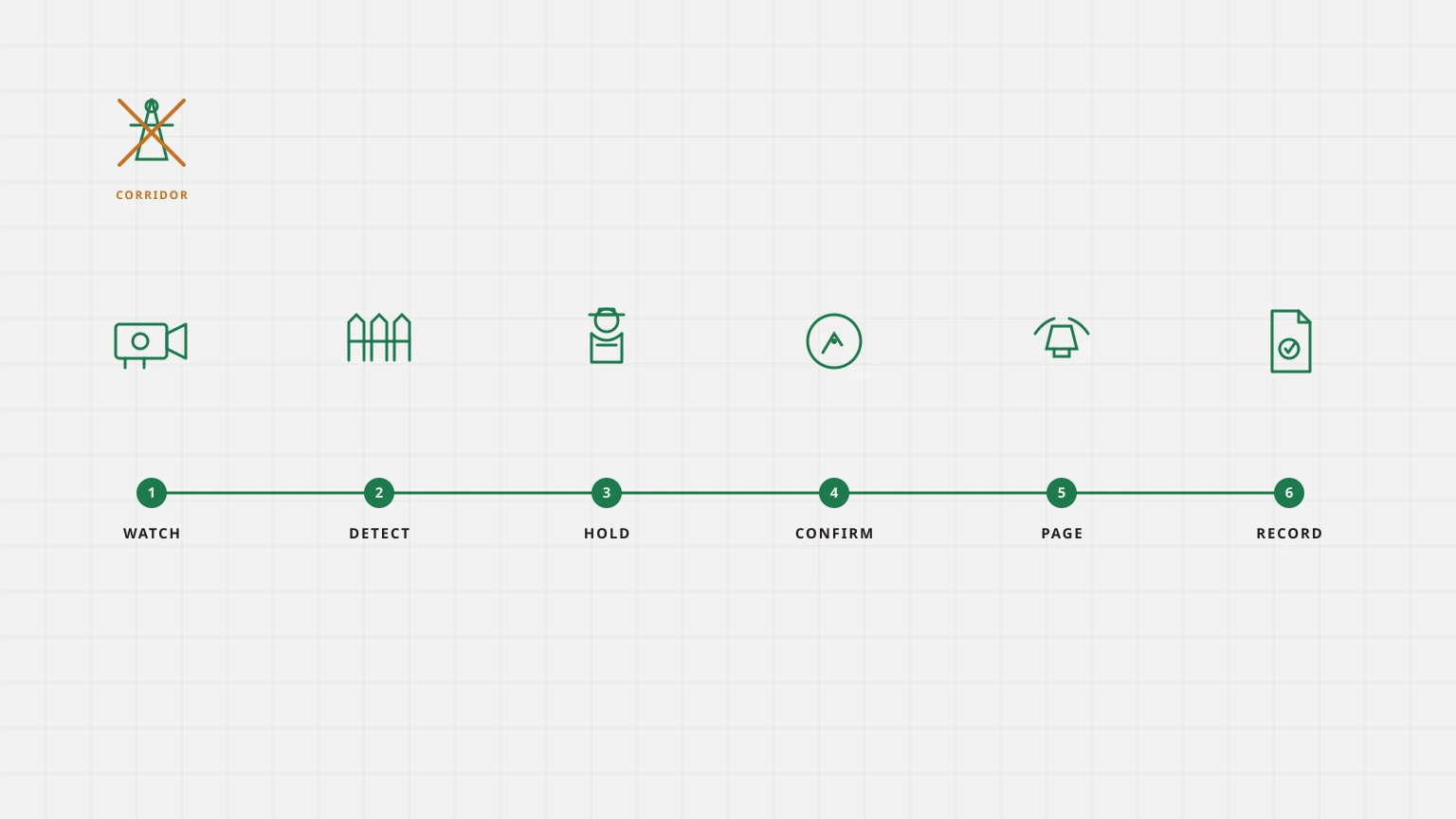
How a plant event becomes a record
You watch the bay you can actually see. You detect the person, the missing kit or the vehicle. You confirm the still. You page the desk. You keep the record. You stay quiet about the corridor.
- 01 Watch
You name the halls, substations and yards that have cameras worth the watch. Sentinel takes a frame from those cameras.
- 02 Detect
A body past the fence, a missing arc-flash suit or a vehicle in the yard becomes a candidate. The hold you set keeps a walker from becoming noise.
- 03 Hold
A person walking the fence line is not an event. A person who stays is. You set that number.
- 04 Confirm
A reviewer on the plant desk accepts, dismisses or escalates. The model does not close the case. A sensor bit corroborates when you have one.
- 05 Page
The people you named for that hall or yard get the still. You choose how loud that page is.
- 06 Record
The event, the still and the review sit in one place when NERC or your board asks who was in the yard. The line between towers is not in that record.
How it runs on your site
The appliance sits on the plant OT network. Air-gapped is supported. Raw video stays on site. Corridor cameras, where you have them at a specific crossing, attach as ordinary zones. They are not sold as a line-wide watch.
Questions operators ask
- Can the camera tell if someone is taking cable?
- No. The camera can tell you that a drum or a pad changed when no work order was open, and that a person was in the yard. Theft is a word investigators use after the fact.
- Do you sit on the SCADA network?
- We read the tags you already publish, such as an energised bit or a door contact. We do not replace SCADA, and we do not write control commands unless you wire a specific action.
- Can you watch the whole transmission corridor?
- No. A right-of-way is not a detection product. A camera at a specific crossing can be a zone. The rest of the line is a patrol, a sensor or a neighbour.
- Is this a replacement for physical security?
- No. It sits on the cameras and sensors you already run so the plant desk is not guessing which alarm is real.
- Does live-bay PPE need a wearable?
- No. Vision is enough to start. We detect the clothing the bay requires when it is visible. We cannot see a rating on a label.
- Where does footage live?
- On the edge appliance on the plant network. Only events, metadata and clips you consent to ever leave. Air-gapped is supported.
We cannot infer vandalism, theft or intent from a still. We will not claim a watch on a transmission corridor, a tower line or a buried cable run you cannot see. A person past the plant fence is a person past the plant fence. You write the rest.
See it on your cameras
Setup in days. A measured 30-day pilot on the feeds you already run.