Industries/Free trade zones
Free trade zonesOne perimeter, many tenants, on the cameras already at the gate
If you run a licensed free zone, or a plot inside one, you already film a shared fence, a bonded gate and a mix of factories, sheds and construction. Those cameras can see a fence crossing, a vehicle leaving without the read it should have had, a person at an unprotected slab edge. They cannot tell whether cargo is under-declared. Customs still has to do that job.
Security
Presence that should not be there
Operations
How the site is turning
HSE
Kit, zones and harm
On the cameras you already run
A free zone is not one factory. It is a customs-controlled estate with a shared perimeter, mixed tenants and, often, live construction on the next plot. You already have cameras on that road. The gap is that the authority and the tenants are looking at different problems on the same feed.
Sentinel sits on those cameras so a factory can watch exclusion paint, a logistics tenant can watch dwell at the dock, and a construction plot can watch a person at an edge without a visible harness, without mixing those rules. The authority sees events. Each tenant keeps its own footage.
NEPZA, OGFZA and Nigeria Customs still expect a movement record at the bonded gate. That record stays on site. A vehicle that leaves without the read it should have had is a flagged movement, not a customs declaration.
What goes wrong on these sites
A crossing of the shared zone fence
Unauthorised entry onto a customs-controlled estate is a zone-authority problem first. A person or vehicle on the fence line, especially after dark, is the page the patrol actually needs.
A vehicle leaving without the read it should have had
A bonded-gate exit with no matching gate-pass or RFID is a duty exposure and a Customs conversation. The camera does not declare the cargo. It flags a movement that does not match the read.
A tenant boundary crossed after hours
Plots share a road and a fence. A person or vehicle on the wrong plot outside permitted hours is how inter-tenant disputes start, and how liability gets argued with no shared evidence.
A factory floor on a tenant plot
PPE gaps, exclusion-zone entry and forklift-pedestrian proximity on a manufacturing tenant are the same events as a standalone plant. They stay on that tenant's trail.
A person at an unprotected edge
Construction plots inside a zone still kill people. A person at a slab edge or on a scaffold without a visible harness, or under a suspended load, is a site-supervisor page and a stoppage risk.
A gate that cannot turn
Queue length and dwell past the threshold you already run, or a vehicle on site with no plate or pass match, is throughput lost and an audit trail that will not stand up.
Smoke or flame on a dense estate
One fire on a mixed estate is everybody's loss. Estate-wide fire and smoke sits on the authority trail as well as the tenant's.
A coverage gap across tenant cameras
Fragmented CCTV is how a disputed incident ends with no shared frame. Tamper and a dark camera are the alarm, not a footnote.
What we watch for
Security
- A person or vehicle crossing the shared zone fence, or waiting there after dark.
- A second person through a gate on one badge.
- Plates read at the zone gate, checked against the pass list you already run.
- A bonded-area exit that does not match the pass or RFID it should have had.
- A camera that has been moved, covered or blinded.
Operations
- Gate and weighbridge throughput, so the estate road is not a rumour.
- Truck dwell past the window the tenant already books.
- A blocked estate road that stops the next plot from turning.
- Occupancy on shared roads you have drawn as zones.
HSE
- PPE, exclusion-zone and forklift events on a factory tenant, kept on that tenant's trail.
- A person at a slab edge or under a suspended load on a construction plot, without a visible harness.
- Fire and smoke across the estate, on both the authority trail and the tenant's.
When a camera is not enough
The zone already runs PIDS or fibre on the fence, barriers, turnstiles, RFID badges, weighbridges and, on some plots, gas and flame. Sentinel reads those bits. It does not replace the gate system.
RFID plus a plate plus a person at a bonded gate confirms a lawful movement and flags a mismatch. A factory tenant, a logistics tenant and a construction plot do not share one detection profile. The trails stay separate.
What happens when we see it
Night fence crossing
When PIDS and the camera agree, floodlight and siren if you have wired them. Zone control and the patrol are paged. The log holds both signals.
Bonded-gate pass or plate mismatch
The barrier can hold. Customs liaison is notified. The movement record is flagged. The camera does not invent a declaration.
Person at an unprotected edge without a visible harness
The site supervisor is paged and a ticket is opened. Review can sit in front of reportable files. We detect a harness that is not visible. We cannot see whether one that is visible is clipped to anything.
Forklift and pedestrian too close at a logistics tenant
A local strobe or horn. The operations record stays on that tenant's trail, not the authority's.
From the zone gate to the tenant record
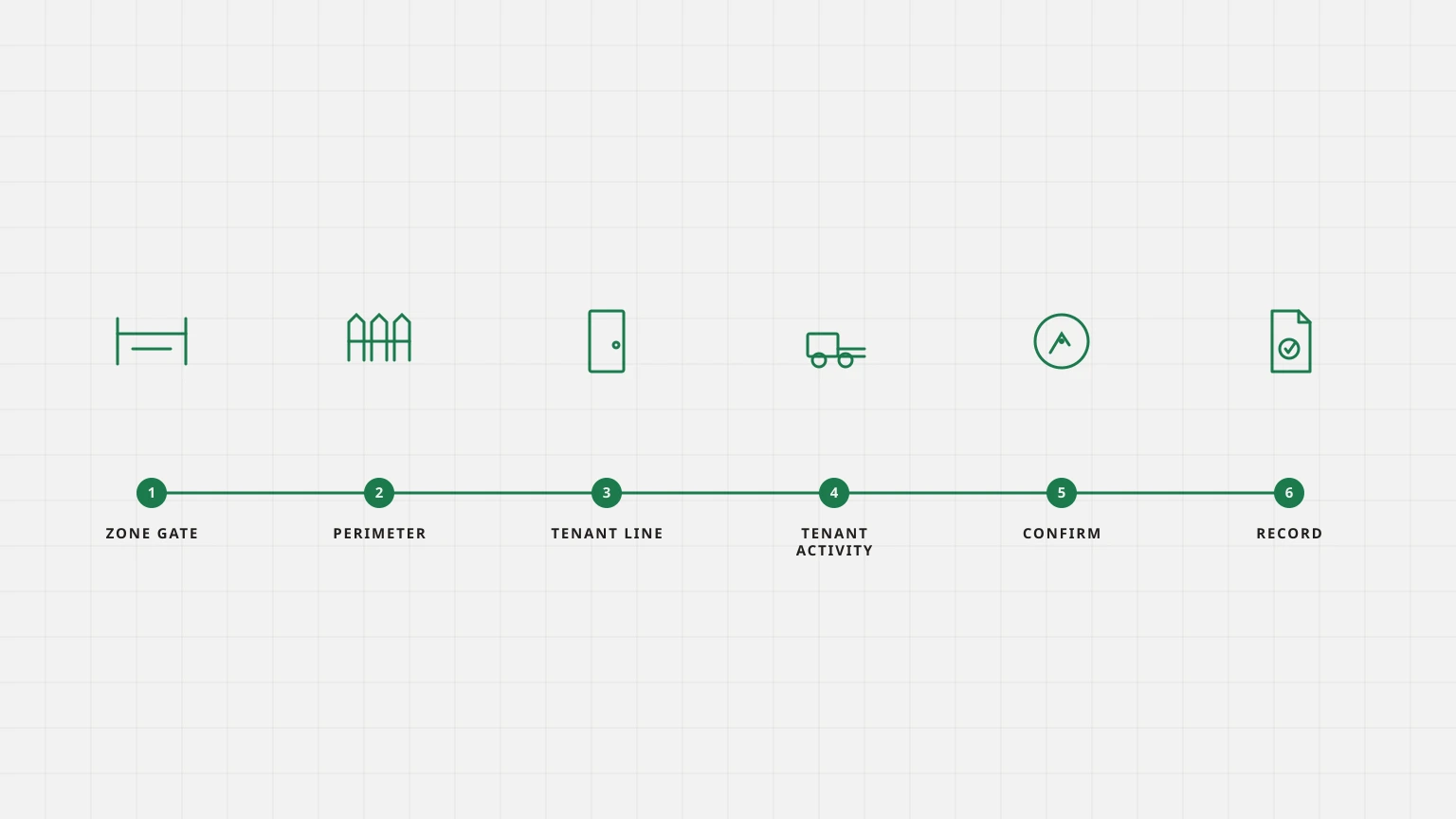
The estate is one road and many plots. The loop follows a vehicle or a person from the zone gate, along the perimeter, across a tenant boundary, into the activity that belongs to that tenant, then into two trails: events for the authority, footage for the tenant.
- 01 Zone gate
Plates, badges and the day's pass list meet the camera at the barrier you already run.
- 02 Perimeter
The shared fence is watched as a zone-authority problem, not a tenant one.
- 03 Tenant line
A plot boundary after hours is a different event from a zone-fence crossing.
- 04 Tenant activity
Factory, logistics or construction: each plot keeps its own detection profile.
- 05 Confirm
A sensor bit plus a frame, with optional review before a reportable file is signed.
- 06 Record
The authority sees events. The tenant keeps footage. The trails stay separate.
How it runs on your site
One edge appliance per zone or cluster can attach any RTSP or ONVIF tenant feed. Each tenant's footage stays on site. The zone authority gets events-only oversight. Rule sets stay separate so a factory and a construction plot are not scored the same way.
Questions operators ask
- Can one platform serve the authority and the tenants?
- Yes. Separate rule sets and separate trails. The authority sees events. The tenant keeps footage.
- Do you monitor bonded areas?
- Yes, against the gate-pass or RFID you already run. A vehicle that leaves without the read it should have had is a flagged movement, not a customs declaration.
- Can HSE profiles differ by tenant?
- Yes. A factory, a logistics shed and a construction plot do not share one detection profile.
- What about construction safety on a live plot?
- Harness visibility, suspended load, and plant-pedestrian proximity, tuned for dust and mixed mast heights. We cannot see whether a visible harness is clipped to the structure.
- Can you unify tenants' cameras?
- Any RTSP or ONVIF feed can attach. We do not require a rip-and-replace of tenant CCTV.
- Where does footage live?
- On site. Events-only for the zone authority.
We cannot tell whether cargo is under-declared. We can tell whether a vehicle left a bonded area without the read it should have had. We cannot detect a harness that is worn but clipped to nothing. We detect its visible absence.
See it on your cameras
Setup in days. A measured 30-day pilot on the feeds you already run.