Industries/Manufacturing
ManufacturingPlant-floor cameras that see the aisle, the hatch and the exclusion paint
If you run an FMCG, cement, steel, brewery or packaging plant, the cameras over the line already see a limb inside a marked exclusion zone, a forklift closing on a pedestrian, a hatch with no attendant in frame. They cannot see whether a lock is on an isolator. The PLC can. Together they give a supervisor something to act on before the shift is lost.
Security
Presence that should not be there
Operations
How the site is turning
HSE
Kit, zones and harm
On the cameras you already run
You already film the line, the forklift aisle, the confined-space hatch and the finished-goods store. Most of that footage is a record of what already happened. When the Factories Act, or ISO 45001 if you run it, asks who was in a dangerous place and when, you should not have to reconstruct it from a radio call.
Sentinel sits on those cameras so a body inside guarded paint while the machine is still live, or a forklift and a person sharing an aisle, becomes a page to the shift supervisor. The camera names the body. The PLC or interlock names the machine state. You still choose whether a line-stop wire exists.
A 30-day pilot sits on the feeds you already run. Video alone does not stop a line. The record of what happened sits on the plant network so the next toolbox talk is not guesswork.
What goes wrong on these sites
A limb inside a guarded zone while the line is live
When the camera sees a person in the exclusion paint and the PLC still reads energised, that is the event that amputates. The page can carry a line-stop signal if you have wired one. The camera cannot see a missing padlock. It can see the person standing where the machine state says nobody should be.
A forklift and a pedestrian sharing an aisle
Most forklift fatalities involve a person on foot. Vision proximity is enough to start. A strobe or horn at the intersection, and a telematics flag if the truck reports one, turns a near-miss into a record instead of a rumour.
A hatch entered with no attendant in frame
Confined-space work still kills people who went in alone. We watch hatch presence and whether an attendant is visible. We cannot measure gas. The detector does that, and we confirm who entered.
Smoke in packaging or a dusty hall
Steam and dust fool a video-only smoke flag. Where you have a detector, we join the two. A video-only flag in a steam-heavy hall stays at a low tier so the shift does not learn to ignore it.
Missing kit on the line
A person without the hi-vis, hearing, eye or foot protection the zone requires becomes a leading-indicator ticket, not a surprise in next month's audit.
Someone in the finished-goods store after hours
A person in the store or yard outside shift, or a door left open on a cage, is a chain-of-custody gap. The camera does not name a thief. It names a body where the store should be empty.
Something left in a fire-exit lane
A pallet or a vehicle parked in marked egress turns every other incident into a worse one. An unattended-object check on those lanes is a simple rule with a clear cost.
A camera that has been moved or blinded
When the overhead lens over an exclusion zone goes dark, you have lost the only frame that would have joined the PLC bit. That is the alarm.
What we watch for
Security
- A person or vehicle crossing the plant perimeter or the gate you already film.
- Someone in the finished-goods store or cage after the shift has closed.
- Plates read at the weighbridge and the gate, checked against the list you keep.
- A camera that has been moved, covered or blinded.
Operations
- Whether the line is occupied, so a stoppage is a record instead of a story.
- A pallet, a truck or a person blocking a pathway or a fire-exit lane.
- Throughput at packaging against the window you already run.
- Dwell at bays past the time the dock already treats as a problem.
HSE
- Hi-vis, hearing, eye or foot protection missing in the zone that requires it.
- A person inside a machine exclusion zone you have painted and drawn on the feed.
- A forklift and a pedestrian sharing an aisle they should not share.
- A person in a maintenance zone while the line is still live.
- Hatch entry, and whether an attendant is visible in the same frame.
- A person down, and fire or smoke where a detector can corroborate it.
When a camera is not enough
A person in an exclusion zone is a camera event. A machine that is still energised is a PLC event. Neither sentence is enough on its own. Sentinel reads interlocks, isolation status where it is instrumented, door contacts, forklift telematics and smoke detectors.
A person in the paint plus a PLC that reads energised is a high-confidence unsafe event. Telematics over-speed plus a pedestrian in frame is a verified near-miss. Video alone does not stop a line. You choose whether that wire exists.
What happens when we see it
Person in a guarded zone while the machine is live
A line-stop signal can go to the PLC if you have wired it. The supervisor is paged. The event becomes a near-miss record with the frame and the machine state.
Forklift and pedestrian too close
A strobe or horn at the intersection, plus a telematics flag if the truck reports one. Operations keeps the record.
PPE gap on the line
The shift supervisor gets a WhatsApp and a ticket. It is a leading indicator, not a hearing, unless you make it one.
Smoke in packaging, and a detector agrees
The fire panel and PA are notified. An incident record is opened with the clip.
The shift-safe loop
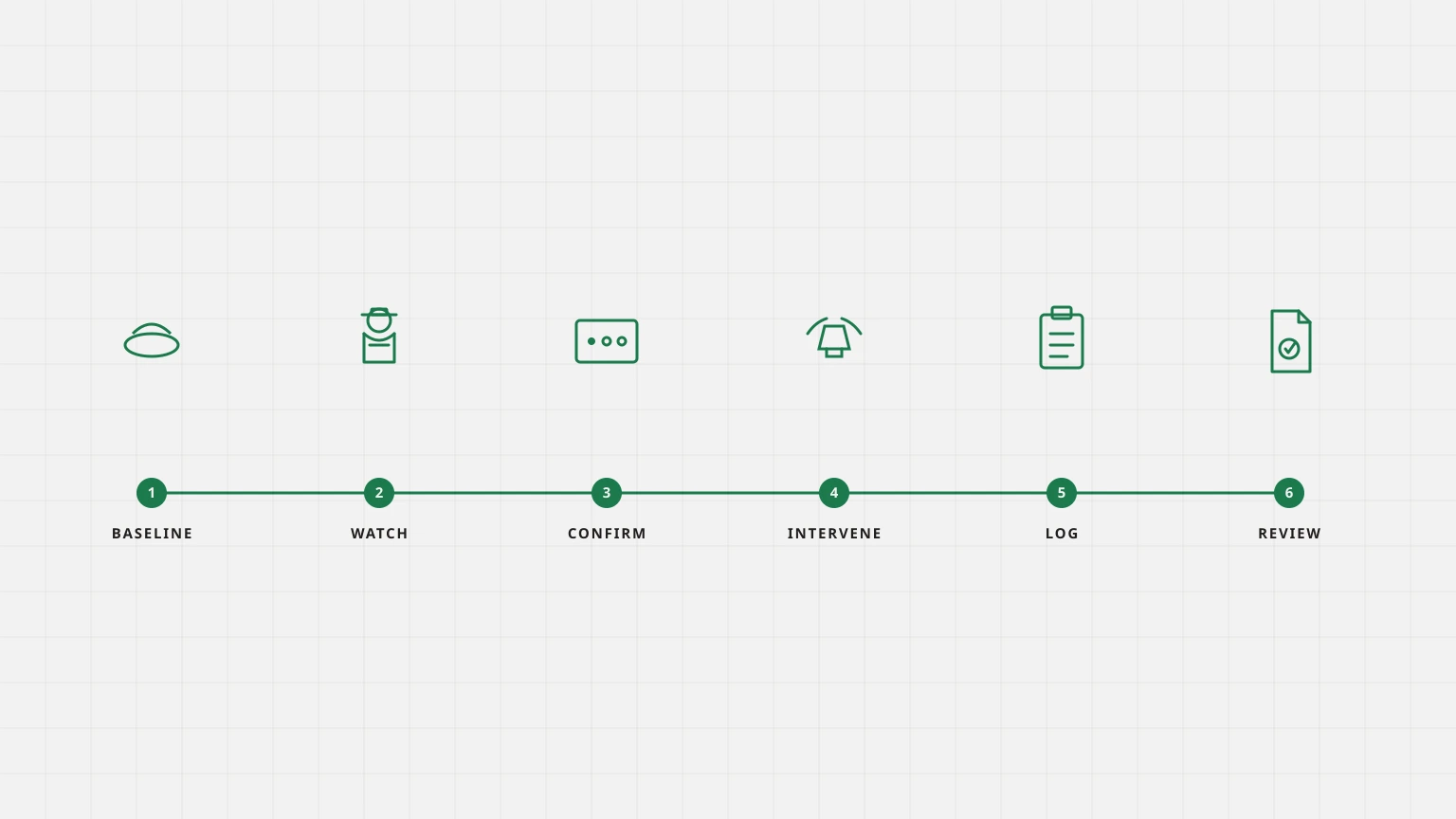
A plant does not need a new camera estate. It needs a loop the shift can trust: baseline the zones you already painted, watch them, confirm with the PLC when the machine state matters, then log what happened so the next toolbox talk is not guesswork.
- 01 Baseline
We sit on the cameras and the zones you already have: exclusion paint, hatch, aisle and store.
- 02 Watch
Security, operations and HSE packs read every attached feed for the shift.
- 03 Confirm
A person in a zone plus a PLC or interlock bit is the high-confidence event. Review is optional for recordables.
- 04 Intervene
Supervisor page, strobe, or a line-stop signal if you have chosen to wire one.
- 05 Log
The frame, the zone and the machine state sit on the plant network.
- 06 Review
Leading indicators for the next ISO 45001 conversation, not a surprise in an audit.
How it runs on your site
The appliance sits on the plant OT network. Line-stop, if you want it, needs on-site inference. Air-gapped is supported. Raw video stays on site.
Questions operators ask
- Can you stop a line on zone entry?
- Yes, via a PLC signal when a person is in the exclusion zone and the machine is still energised. Video alone does not stop a line. You choose whether that wire exists.
- Does this produce ISO 45001 leading indicators?
- Yes. Confirmed PPE gaps, proximity events and exclusion-zone entries become structured records a safety meeting can actually use.
- Does forklift safety need wearable tags?
- No. Vision proximity is enough to start. Forklift telematics is an optional extra, not a prerequisite.
- What about dust and steam?
- Models are tuned against steam and dust, and fused with a detector where one exists. A video-only smoke flag in a steam-heavy hall stays at a low tier.
- How do you treat confined space?
- Hatch presence plus attendant presence, and permit reading when a permit is actually in the frame. We cannot measure gas. The detector does.
- Where does footage live?
- On the edge appliance. Air-gapped is supported. Only events, metadata and clips you consent to ever leave.
We cannot see whether a lock is on an isolator. We see a person where the machine state says nobody should be. We cannot measure gas in a confined space. The detector does, and we confirm who entered and whether an attendant was present.
See it on your cameras
Setup in days. A measured 30-day pilot on the feeds you already run.